When to Retire Your Ratchet Straps?
In industrial lifting and logistics transportation, ratchet straps are hailed as the “seatbelts” of cargo. However, many experienced drivers and warehouse managers often have a fatal misconception: “As long as the strap isn’t broken, it can still be used.”
In fact, damage to fiber webbing is often insidious. Once the strap reaches its wear and tear, but is still used, even tiny tears can tear instantly under immense tensile force during high-speed driving or emergency braking, leading to cargo damage or even catastrophic traffic accidents.
To ensure operational safety, please be sure to conduct regular “check-ups” on your lashing straps according to the following standards.
I. Visual Red Line: Visible signs of obsolescence
Key Signal: Missing Tag Requires Disposal. Even if the strap looks new, it must be stopped if it lacks a load label.
Webbing Wear: Fuzzy Appearance indicates damaged load-bearing fibers.
Surface Cuts: Any perforations or cuts on the webbing surface.
Stitching: Pay special attention to checking for broken stitching at joints. If the stitching comes loose, the load distribution will fail.
II. The Invisible Killer: Environmental and Chemical Damage
Some webbing may appear intact, but its physical properties have changed:
UV Degradation: Webbing exposed to direct sunlight for extended periods will fade, feel hard and brittle to the touch, and may even shed powder. This indicates that the fiber molecular chains have broken, significantly reducing its load-bearing capacity.
Heat Damage and Arc Burns: The appearance of melted, charred, or hardened “weld slag spots” on the webbing indicates that the fibers in that area have lost their elasticity.
Chemical Corrosion: Contact with acids and alkalis may cause the webbing surface to discolor or become abnormally brittle.
III. Hardware Inspection: Health of Ratchet and Hooks
The binding strap is not just about the webbing; the performance of the metal parts is equally crucial:
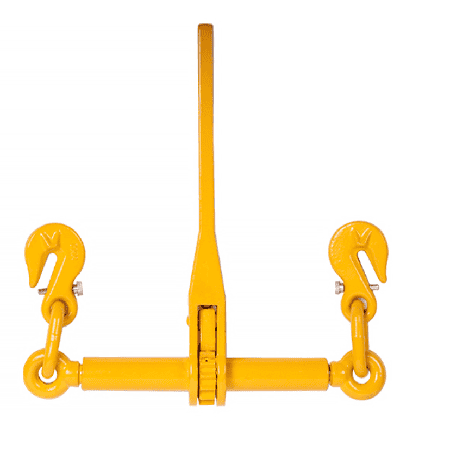
Deformation and Cracks: Are there signs of the hooks opening? Is the ratchet frame bent?
Functional Failure: Are the ratchet gears severely worn, causing stripping? Is the spring faulty, preventing it from locking?
Corrosion Level: Slight surface rust is acceptable, but deep, pitted corrosion necessitates replacement.
How to extend the lifespan of ratchet straps?
Use edge guards: When strapping goods with sharp edges (such as steel coils or planks), edge guards must be used to prevent cuts.
Never knot: Never shorten the strapping by knotting.
Store properly: After use, wash away any dirt and sand (grit will abrade the internal fibers), and store in a dry, cool place, avoiding prolonged exposure to sunlight and moisture.
Conclusion
In the field of safety, we have a rule: “When in doubt, throw it out.” As professional logistics or crane operators, conducting regular standardized inspections is not only a responsibility to the goods but also a respect for life.
Contact us to request: Daily Safety Checklist for Tie-Up Straps