Recovery Strap vs Tow Strap: What’s the Difference
In heavy-duty rescues or road towing, choosing the wrong tow strap can not only damage equipment but also potentially cause serious industrial accidents. As a leading global supplier of lifting and tensioning solutions, we are frequently asked: ‘Can I use a regular trailer hitch for off-road rescues?’ The answer is: Absolutely not. This article will explain the science and safety specifications behind it.
What Is a Recovery Strap?
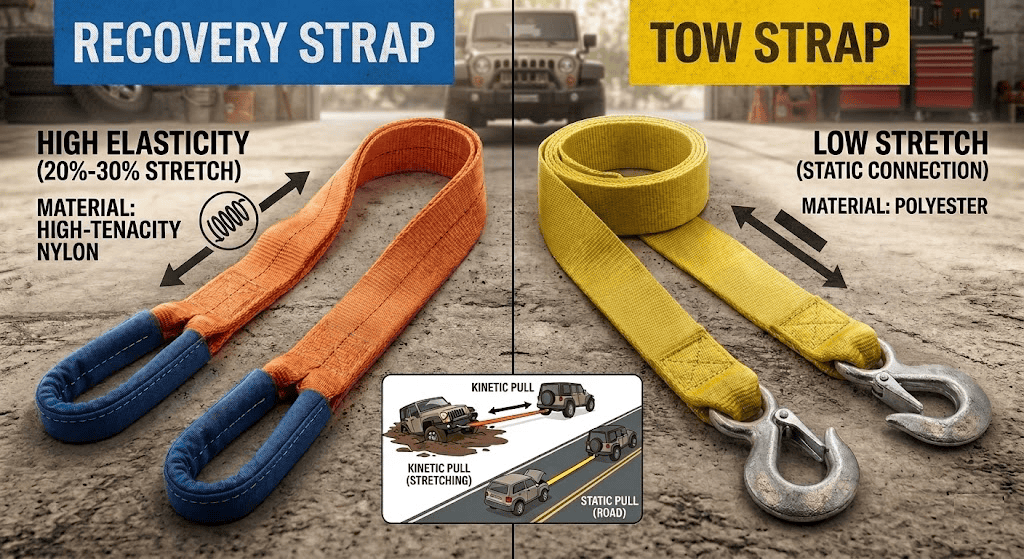
Definition: Used to pull vehicles out of mud, sand, snow, and other similar environments.
Features:
High elasticity
Can generate kinetic energy recovery
Generally made of nylon
Working principle: When the vehicle is stretched, the strap elongates and stores energy, then releases the force to pull the vehicle out.
What Is a Tow Strap?
Definition: Used for towing or moving a vehicle from point A to point B.
Features:
Almost no elasticity
Typically made of polyester
More stable structure
Suitable for smooth towing
Typical scenarios:
Towing a disabled vehicle to a repair shop
Towing on flat roads
Differences Between Recovery Strap and Tow Strap
| Feature / Specs | Recovery Strap | Tow Strap |
| Material | High-Tenacity Nylon | Polyester |
| Elasticity | High Stretch (Typically 20% – 30%) | Low Stretch (Minimal to zero) |
| Primary Function | Rescuing vehicles stuck in mud, sand, or snow | Towing free-rolling vehicles on paved roads |
| Working Principle | Kinetic Energy: Acts like a rubber band to “pop” the vehicle out | Static Pulling: Provides a steady, rigid connection |
| End Fittings | Reinforced Loops (Eyes): Used with shackles for safety | Steel Hooks: Designed for quick attachment (Light-duty) |
| Shock Load Resistance | Excellent: Specifically designed to absorb sudden impact | Very Poor: Prone to snapping or causing hook failure under tugs |
| Recommended Use | Off-road recovery, heavy-duty snatching | Roadside assistance, moving disabled vehicles |
| Safety Warning | Do NOT use for long-distance towing (causes surging) | NEVER use for snatch recovery (high risk of snap-back) |
Tow straps are not suitable for impact dragging.
Safety Tips When Using Recovery or Tow Straps
Always inspect the strap before use
Never exceed the rated capacity
Use properly rated recovery points
Keep bystanders away from the strap during operation
Avoid sharp edges that could damage the webbing
FAQ: Recovery Straps & Tow Straps(People Also Ask)
Q1: Can I use a Tow Strap for off-road recovery?
A: Absolutely not. A Tow Strap is made of polyester with minimal stretch. Using it to “snatch” a stuck vehicle creates a massive shock load that can snap the strap, damage the vehicle chassis, or cause metal hooks to fly off dangerously. For recovery, always use a Kinetic Recovery Strap made of nylon.
Q2: Why are metal hooks discouraged for heavy-duty recovery?
A: In a high-tension recovery, if a strap snaps or a recovery point fails, a metal hook becomes a lethal projectile. Professional recovery straps (Kinetic ropes/straps) usually feature Reinforced Loops designed to be used with Soft Shackles or rated steel D-shackles for a much safer connection.
Q3: How often should I replace my straps?
A: You should inspect your straps after every use. Replace them immediately if you see:
- Any nicks or cuts (even small ones) on the edges of the webbing.
- Frayed stitching at the loops.
- Discoloration or stiffness (signs of UV damage or chemical exposure).
- Visible dirt/grit embedded deep in the fibers that cannot be washed out.
Q4: What strap length is recommended for vehicle recovery?
A: Most recovery straps are 20 ft (6 m) to 30 ft (9 m) long.
This length provides enough distance for the recovery vehicle to build momentum while maintaining a safe gap between vehicles.
Conclusion
Recovery straps save vehicles from being stuck; tow straps keep them moving on the road. Choosing the correct strap not only improves recovery efficiency but also ensures safety for both vehicles and operators.